Archive for November, 2009
I See Trees of Green…
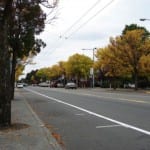
We all know Seattle to be the Emerald City and if you look on most neighborhood streets, you can see why. Our city is dedicated to keeping a green landscape by increasing the number of trees in the city over the next 30 years through the Seattle ReLeaf program. SDOT’s Urban Forestry Division plays a major role in keeping our streets adorned with green by planting and maintaining street trees. We currently have 152,000 street trees. Though there are many varieties of trees that make up this number, the top ten are:
- Cherry (including purple leaf plums)
- Maple (including Red and Norway Maples)
- Hawthorne
- Crabapple
- Oak
- Linden
- Ash
- Sweetgum
- Birch
- Dogwood

All in all, we have an inventory of over 500 different types of trees! An ever greening landscape…what a wonderful world.
[More]Posted: November 16th, 2009 under General.
A Countdown to Cross By
So by now you are probably pretty familiar with some of the Intelligent Transportation System (ITS) technologies we use throughout the city to help with traffic. You’ve seen the dynamic message signs we use to alert travelers of roadway conditions, the traffic cameras we use to look out for incidents, and the license plate readers that help record the average travel time from an origin to a destination in the area. This data is used for SDOT’s Travelers Information website which provides a visual of real time traffic conditions.
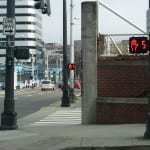
While these particular technologies help inform travelers in automobiles, we use ITS to help inform pedestrians as well. You know those “new” pedestrian countdown signals at intersections throughout the city? Those are designed to help pedestrians make safer decisions by informing them of the time remaining to cross the street. The countdown is used together with the traditional “walk” and “don’t walk” symbols. Timing for the pedestrian signal is calculated by measuring the curb-to-curb distance and dividing that length by 4 feet per second. This calculation is a federal standard, but can be adjusted to allow 3 ½ feet per second, or lower, if the crossing is frequently used by seniors or children. The countdown does not include the time the traffic signal is yellow or red. Once the flashing red hand turns solid and the countdown ends a crossing should be complete.
We installed countdown signals at 40 locations in 2009 and plan to install an additional 40 locations next year.
[More]Posted: November 13th, 2009 under General, Peds.
Open house scheduled for today on the NE 45th St. Viaduct Project
The NE 45th Street Viaduct is scheduled to be replaced during the summer of 2010
The NE 45th Street Viaduct’s existing 468-foot west approach is nearing the end of its structural life and needs to be replaced.
SDOT is hosting an Open House today, Thursday, November 12 from 4:30 – 7:30 p.m. at the University Presbyterian Church (4540 15th Avenue NE, Seattle, 98105) to talk with neighbors, businesses and commuters about the project.
For more information
Visit the project Web site: www.seattle.gov/transportation/45th-bridge
Or e-mail: NE45thBridgeRehab@Seattle.Gov
[More]Posted: November 12th, 2009 under General.
Celebrating our veterans
At SDOT and all around the nation we are rembering and honoring those who served our country. Happy Veterans’ Day.
[More]Posted: November 11th, 2009 under General.
Snow Response Rehearsal Continues
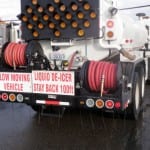
Today the Seattle Department of Transportation (SDOT) continued its dress rehearsal of its aggressive new snow-fighting plan by deploying its snow response fleet on city streets. At approximately 4:00 a.m. this morning, more than 20 trucks equipped with snow plows rolled out of SDOT yards to follow the prescribed sequence and turns for each snow route, confirming that each route is well defined and the time allotted is appropriate.

SDOT Flusher Truck out Rehearsing Snow Plan
During today’s exercise, managers used the new GPS tracking system to follow the vehicles’ progress, operate traffic cameras to “monitor storm conditions,” and use temperature and humidity devices to help determine what materials and usage rates are needed during an actual storm. Additional information about the new snow and ice response plan can be found online at http://www.seattle.gov/Transportation/winterweather.htm.

SDOT Tanker Truck Preparing for Snow Rehearsal
Posted: November 10th, 2009 under General.
Our Living (Leafing) History
We’ve gotten a few questions about Seattle’s street trees on our Q&A page recently, reminding us that lots of readers might not know about the Seattle Department of Transportation’s role in caring for the city’s tree canopy. Not only does SDOT assist drivers, cyclists, freight delivery people, pedestrians and transit riders, we also manage all of Seattle’s over 130,000 street trees. Staff in SDOT’s Urban Forestry Division combine educational and regulatory efforts to ensure proper planting, pruning and removal practices for trees along Seattle streets. We even have an official City Arborist!

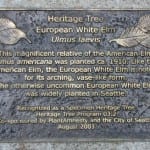
The plaque recognizing a 2003 Heritage Tree in Roanoke Park on Capitol Hill
One of the programs administered by Urban Forestry is the Heritage Tree Program. The first Seattle Heritage Tree was recognized jointly by the City of Seattle and PlantAmnesty in 1996. In the 13 years since, many more Heritage Trees have been celebrated.

And the beauty itself!
Heritage trees may be on either City or private property. Each candidate tree is assessed by a certified arborist and evaluated by a review committee. Candidate trees must meet criteria for health and fit into one of the following categories: a tree of exceptional size, form, or rarity; a tree recognized as historic; trees that are landmarks of a community; or collections of trees in a notable grove, avenue, or other planting.
Each Heritage Tree is identified by a plaque and the owners are given an owner’s tree care manual. A few owners even have chosen to place a deed restriction on their property to provide for future tree protection. You can find a full list of Seattle’s Heritage Trees and more information here. Many of the trees are truly awe-inspiring and worth seeing in person. If you find one on the list in your neighborhood it would make a worthy destination for a hike through our urban forest!
[More]Posted: November 9th, 2009 under General.
Pedestrians and Daylight Savings Time

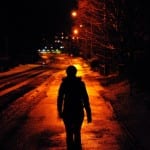
Photo by Photographic art of Chrystal Image / Mikko Hiukka
When daylight savings time ends, it takes a few weeks for us to adjust to darker conditions earlier in the evening. After enjoying long hours of daylight in the spring and summer, we are suddenly faced with darkness before 5 p.m. And “falling back” has been shown to have serious implications on traffic safety in the evening hours.
A 2007 study by professors Paul Fischbeck and David Gerard of Carnegie Mellon University found that pedestrians walking during the evening are nearly three times more likely to be stuck and killed by cars in the weeks after the time change.
Their study of pedestrian fatalities from 1999-2005 shows that there is an average of 37 more U.S. pedestrian deaths around 6 p.m. in November compared to October. That amounts to an increase of 186 percent.
The study found that it is not the darkness itself that leads to the increase in incidents but the adjustment to earlier nighttime. Pedestrian fatalities decline with each passing month as we adapt to the darker conditions.
While it’s always important to expect pedestrians when driving, be extra careful now as we adjust to the earlier onset of nighttime.
[More]Posted: November 6th, 2009 under Bikes, General, Peds, Streets for People.
Update: Weekend Transformations

UPDATE: the rain storm won this one, and has bumped work out a bit. We’ll keep you posted on the newly scheduled weekend transformation! In the meantime, Third Avenue will remain open to traffic.
[More]Posted: November 5th, 2009 under General.
Weekend Transformations
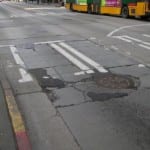
If you like to see “immediate” results for your tax dollars, take a drive along Third Avenue between Pike and Virginia streets tomorrow, then come back for a look-see on Monday (assuming the work isn’t postponed by rain…). Improvements to Third Avenue are a recent addition to SDOT’s busy 2009 paving season and because the roadway is a major trolley bus corridor during rush hour, downtime on the weekdays wasn’t an option. Hence the plan for two weekend transformations, the first done October 24th and 25th with crews replacing about a dozen concrete panels between Union and Spring streets from 8 a.m. to 10 p.m. Saturday (Sunday was just for concrete to cure).

Concrete panel work along Third Avenue Before Transformation

Concrete panel work along Third Avenue After Transformation
This weekend crews will turn on a dime yet again, finishing improvements in only two days (unless rain douses the schedule and bumps some elements out). To get this next set of concrete panels replaced the roadway will have to be closed between Pike and Stewart streets, and Stewart and Virginia streets. Remember the closure is brief, and the “makeover” will make for a smoother ride.
[More]Posted: November 5th, 2009 under General.
Family of four thrives with One Less Car

When it is NOT raining, it is a little easier to imagine getting around like this family does. But read on, by the time this story is finished; you might decide it is the Way to Go.
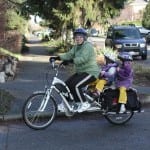
A preschooler asking, “Mommy, why can’t we ride a bike to school like those guys?” as you arrive to school with your two kids on the back of your Xtracycle…getting smiles when you ride the bus with your three and five year-old daughters…losing ten pounds from biking with those cute kids on that Xtracycle. These are just a few of the benefits that Kari and husband Akwetee have enjoyed since selling their second car in the City of Seattle’s One Less Car Challenge.
Kari, Akwetee, and their two daughters recently completed their year in the One Less Car Challenge—a City program to encourage Seattleites to drive less and bike, walk, and use transit more often. Participants sell a car, commit to live with one less car for a year, and receive hundreds of dollars in incentives. Seattle Department of Transportation (SDOT) provides participants with $200 in gift certificates to buy transit passes or REI gear, ZipCar provides use of their car share vehicles, and Cascade Bike Club and the Bike Allianceprovide a free annual membership. Other incentives include a $100 discount from Tiny’s Organic Produce.
Kari found that shedding a car also provides significant ongoing benefits: “We’ve noticed how much money we’re saving on insurance and gas.” (AAA says the typical car costs about $7,000 per year to own and operate.) “We also have less stress with fewer cars to maintain.”
[More]Posted: November 4th, 2009 under Bikes, General, Streets for People.