Archive for October, 2009
Be Safe When You Use Your Feet to Trick or Treat

Halloween is a fantastic occasion to walk about our city and meet our neighbors. While we embrace the Halloween spirit by adorning our favorite ghoulish attire, it’s important to remember that the chance of a child being hit by a car on Halloween is nearly double that of any other night of the year. But Halloween does not have to be that frightening. In fact, Halloween presents us with a great opportunity to practice being safe pedestrians. Here are some tips to help you stay safe tomorrow night:
- The sun will set at 5:53 PM tomorrow evening. If you plan on trick or treating after dusk, be sure that all children carry a glow stick or flashlight and wear reflective clothing.
- Don’t go trick or treating alone. Adults should accompany young children and escort them to the door of every house they approach.
- Walk, don’t run, and stay on the sidewalks.
- Cross the street only at intersections.
- Stop at the curb. Look left, right, left, and over your shoulder for traffic and continue to look for traffic as you cross the street.
- Stop and look around parked cars or other objects that block the view of traffic before you start to cross the street.
- Make eye contact with drivers to make sure they see you.
For more Halloween safety tips, visit the Seattle Police Department’s Halloween safety page. And for information on how you can be a safe pedestrian every day, go to Seattle-King County Public Health’s Pedestrian Safety Page.
[More]Posted: October 30th, 2009 under General, Peds.
Concrete is Flexible
If paving roads is a dry weather sport, why are we starting new projects in the rainy season? Because concrete isn’t as picky as asphalt. That’s the simple answer. More specifically, asphalt is commonly applied at a temperature of 300-degrees-plus and if it cools down too fast the result isn’t stable (compaction, the best indicator of asphalt longevity, is compromised). Also, steam rises from hot asphalt if it’s applied to cold or wet ground, creating voids in the roadway. Concrete, on the other hand, is a hardier sort.

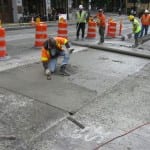
Crews doing concrete work downtown
Though sensitive to scorching heat, concrete can be poured in cold, wet weather with a few adjustments. Don’t laugh, but those adjustments include covering it with warm blankets while it cures (at least it doesn’t ask for chicken soup). In any event, the blankets are only needed in below 40-degree (Fahrenheit) weather because concrete has the added benefit of generating its own heat. Yup, sure does. After it’s poured and starts curing, the chemical reaction in the process creates heat that helps the substance solidify. Granted, the emitting heat couldn’t brown a marshmallow, but every little bit helps and makes concrete projects more flexible (to schedule). Paving Program Manager Jessica Murphy uses that flexibility for planning projects like Fourth Avenue between Jackson and Olive, originally set for 2010 but started in 2009 as part of the Mayor’s economic stimulus package to create jobs. Because the project is all concrete, it can start in yuck weather. However, as helpful as concrete is, it still can’t inherently avoid schedule conflicts (that’d be some fancy curing!). The phasing of the Fourth Avenue Central Business District South project to begin just after this year’s Torch Light Parade and end before next year’s is due to Jessica’s fancy footwork.
[More]Posted: October 29th, 2009 under General.
Think Globally, Act Locally
Last week we posted on Shrinking Big Foot; a program on Climate Change for elementary schools. Well, last Sunday his Excellency the UN Secretary General Ban Ki Moon attended a performance of the Shrinking Big Foot assembly followed by a discussion with the kids who attended. One of the kids asked him “What are the most important issues facing the UN?”. He was very sincere in his reply that Climate Change is one of the biggest issues (along with world hunger). He personally tries to do his part. He says he ends up staying in big hotels all over the world for his job and he is always amazed at how much power they have on when he arrives in the hotel room. He said it sometimes takes him up to 10 minutes to turn it all off.
Sunday’s visit followed another global connection. On the 24th of October, people in 181 countries came together to raise awareness of Climate change and the level of carbon in the atmosphere. The event was organized by 350.org; the City of Seattle helped organize locally. Why “350?” Scientists say that 350 parts per million CO2 in the atmosphere is the safe limit for humanity. We are at 387 now. This December, world leaders will meet in Copenhagen, Denmark to craft a new global treaty on cutting emissions that hopefully will meet the 350 test. At over 5200 events around the world, people gathered in the shape of 3 5 0 or bearing 350 signs, from Bangledesh
to Australia
to under the Space Needle at Seattle Center.
Even more inspirational photos are on the 350.org website.
What can you do? Locally, transportation is our largest source of Global Warming. We figured out if everyone in Seattle drove 20 miles less each week, or 1000 miles a year; we could meet our GHG reduction goals inspired by Kyoto protocol, the last global treaty on cutting GHG emissions. Here are some examples of ways you might be able to drive 20 miles less each week.
[More]Posted: October 28th, 2009 under General, Streets for People.
What a Lovely Planting Strip!

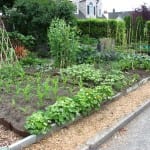
Have you been wondering what you can do with the planting strip in front of your house? Well, in addition to landscaping to your heart’s desire or planting trees, you can also plant fruits and veggies! That’s right, a mini garden, perhaps of the edible variety, in front of your home. This year new rules were created to encourage more gardening in our city.
SDOT has guidelines that will help you in planning your planting project. For instance, we encourage planting low shrubs, perennial, or groundcover plantings that help separate the sidewalk and the street. In addition to the general guidelines on gardening in your planting strip are requirements on height and distance from the right-of-way. Once you have looked over this information, make sure you apply for a free street use permit in order to start planting in the planting strip.

While SDOT does not regulate the type of fruits and vegetables planted, there are certain trees that are prohibited because of the risk of falling fruit. These are trees of the cherry, apple, and pear families. That being said, there is still a lot you can do to green your sidewalk. Maybe you’ll inspire your neighbors to do the same.
[More]Posted: October 27th, 2009 under General.
International Arboriculturists of the World, Unite!
If you were traveling along 35th Ave SW the Friday before last, you probably noticed a ton of activity in the trees lining the street. Troop of misplaced monkeys? Migrating flamingos? Nope, even better. Arboriculturists.

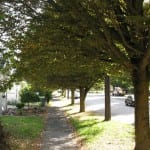
A stretch of trees before the pruning
Approximately 30 Arborists from 12 local tree care firms that are members of the International Society of Arboriculture (ISA) were donating their time to prune SDOT street trees along the road from SW Roxbury to SW Morgan. Despite the cold, pouring rain the event was a success and everyone was in good spirits. A whopping 236 trees were pruned and one large partially-failed European hornbeam was removed. A big thank you to the Parks Department for providing shelter at Camp Long and an even bigger thank you to all the Arborists who participated.
In addition to improving the condition of 236 trees along a major arterial in SW Seattle, this event improved and expanded the knowledge and work practices of local arborists who commonly perform street tree maintenance in the right-of-way. These private firms obtain direct oversight from experienced SDOT arborists and get experience setting up a temporary lane closure on an arterial that conforms to City of standards.
Read more »
Posted: October 26th, 2009 under General.
Capitol Hill Draft Parking Plan

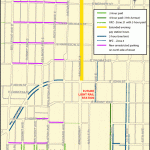
You’ll be interested to know that SDOT has released a DRAFT parking plan for the Capitol Hill study area, bounded by E Roy St on the north, 12th Ave E on the east, E Pine St on the south, and Melrose Ave E on the west. Residents, businesses, and property owners will be receiving a mailer with plan details within the next few days. In addition, details of the plan can be found on our Community Parking Program-Capitol Hill website.
You can also access our survey on that website or here. If you frequent Capitol Hill (and who doesn’t?), take the survey and let us know what you think!
[More]Posted: October 23rd, 2009 under General, Parking.
Safe Routes to School Mini-Grants

The 2009 Orca K-8 Bike to School Day was supported by a Mini Grant
Studies have shown that there has been a dramatic decrease in the number of children that walk or bike to school on a regular basis. Back in the1960s, more than 40 percent of children used their own two feet (in one way or another) to get to school and reaped the health benefits of physical activity in the process. Now less than 16% of students are walking or biking to school. If you’ve ever wondered how you can help reverse this trend, here’s your chance to make an impact. SDOT is now accepting applications for the Safe Routes to School Mini-Grant Program!
Our Mini-Grant Program provides grants of up to $1,000 to schools and community groups for programs that encourage walking and biking to school or improve walk and bike safety. Mini-Grant funds can be used to create a Walking School Bus, plan a Bike Rodeo, organize a Bike Train, create incentive programs encouraging walking &/or biking to school, or purchase new safety gear for school crossing guard programs.
Applications are due October 30th and all the information you need to get going can be found on our website.
[More]Posted: October 23rd, 2009 under General, Peds.
Westlake Square “Triangle” Gets Friendlier

Westlake Square Park bordered by Stewart Street, Sixth Avenue and Westlake Avenue.
Westlake Square, the triangular section of property bordered by Stewart Street, Sixth Avenue and Westlake Avenue, will soon be a more user-friendly public space! As part of the Westlake Hub Transportation Strategy SDOT, in cooperation with Parks, will spend November removing the walking barriers and non-functional items and replacing them with new materials such as new pavement and inlaid solar-powered pedestrian lighting. The goal is to improve pedestrian safety and transit access. Crews will clear away the circular structure that was once a bus shelter; remove low-level brick walls that block walking paths; and salvage the park’s broken fountain and ornamental lights for potential refurbishing and later use in a future City project. Walking surfaces that were damaged earlier this year will also be replaced, in this area that has at times drawn criticism for harboring questionable activity, and the existing honey locust trees will remain.
The interim changes to Westlake Square are a first step in what is envisioned to be a series of enhancements to the terminus of the Seattle Streetcar line and “hub” of transit services at Westlake Avenue. These include improvements to McGraw Square Park, bordered by Fifth Avenue, Stewart Street and Westlake Avenue. For more information on other active and planned improvement projects for the area, please visit the SDOT webpage: http://www.seattle.gov/transportation/westlakehub_streetcarplaza.htm
[More]Posted: October 22nd, 2009 under Bikes, General, Peds, Streets for People, Transit.
It’s a bird, it’s a plane, it’s a hybrid crane
The roadway structures group in SDOT (who maintains our bridges and overpasses, among other things) was one of the first groups in the state to add a hybrid truck in their fleet. When they did, the technology was new and unproven. The group worked with the truck manufacturers to meet their needs and specifications.
The crane operates on battery power; which means the truck does not need to idle (and pollute) to operate the crane. We have also retrofitted all of our trucks to have battery power to operate flashing lights and other equipment. This means they don’t need to idle too. We are seeing huge fuel and pollution savings with these trucks. The crews like them because they are quieter, put out fewer emissions, and they can stay out longer between fueling.
Posted: October 21st, 2009 under General.
Adding a Splash of Color
If you’ve walked through the Pioneer Square area lately, you may have noticed the rather vibrant construction fence in front of King Street Station. SDOT commissioned ArtWorks to design a mural on the construction fence that has been installed around the Jackson Street entrance to the station. ArtWorks is a local nonprofit that provides opportunities for youth to create public art. Many of their creations can be seen on construction fences throughout the city. In some locations, the murals are done on panels that are transported to the construction site. King Street Station’s mural, however, is being painted along the entire length of the fence. Our design reflects Seattle’s signature skyline and the evolution of transportation in our city.
You can check out the great work the ArtWorks youth are doing by walking down Jackson Street. You can also view the mural design on the King Street Station website. We expect the project to wrap up by the end of the month.
Posted: October 20th, 2009 under General.