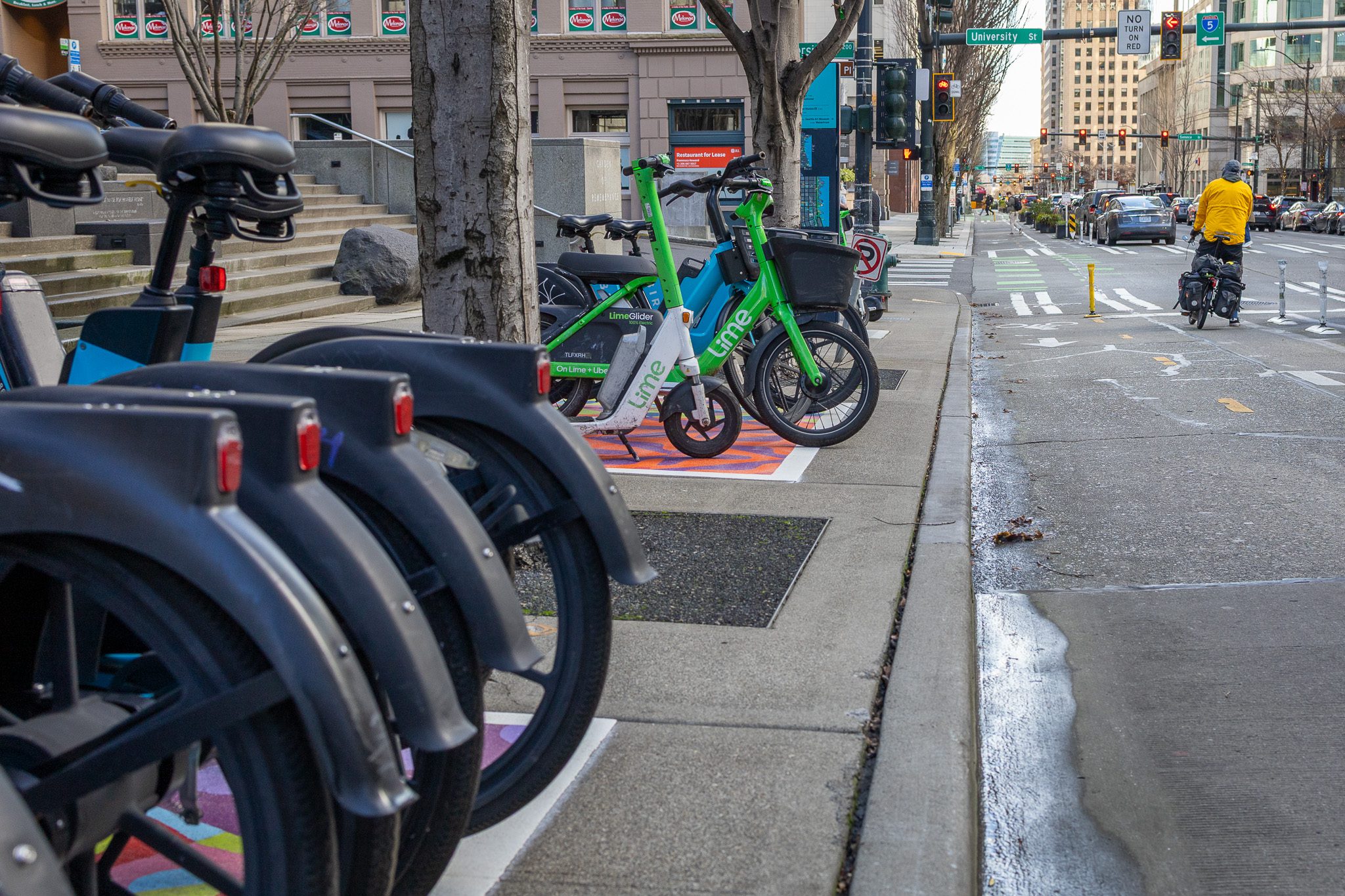
 Shared bikes neatly parked in two new parking corrals in Downtown Seattle, near the Symphony 1 Line light rail station. SDOT is more than tripling the number of bike and scooter corrals downtown by summer 2026, ahead of the FIFA World Cup. The new corrals are being installed where data shows they are needed most, before continuing to expand parking across the city. Photo: SDOT
 Editor’s note: This story was published with a few weeks left in the year. By the end of 2025 the total rides surpassed 10.5 million.
At-a-glance:
- Seattle’s bike and scooter share program hit a record-breaking 10 million rides in 2025, with trips up more than 60% from last year.
- That would be the equivalent of about 26,000 fewer car trips on Seattle streets every day, if each ride replaced a car trip.
- In 2025, people took over 1 million trips using the discount program. You can find out if you qualify for discounted fares on our website.
- In 2025, SDOT added and upgraded more than 13 miles of protected bike lanes to improve safety and connectivity.
- Just in time for the FIFA World Cup, we are tripling downtown bike and scooter parking. By summer 2026, we will add 200+ new corrals in key data-driven locations.
- Free and discounted rides are available for those who qualify. Learn more at seattle.gov/BikeShare.
- 5,000 free helmets were distributed in 2025, and everyone is welcome to pick up a helmet at one of our Customer Service Centers across Seattle.
Seattle’s bike and scooter share program just reached a record-breaking 10 million trips in 2025 alone, with a couple weeks still left to go in the year.
That’s over 60% more trips than last year, and roughly the equivalent of every resident in Seattle taking 12 trips per year.
As our shared micromobility program continues to grow year-over-year, we at the Seattle Department of Transportation (SDOT) continue to build a transportation network that serves all travelers.
A connected bike network provides a comfortable place for people to ride, reducing riding on sidewalks. Additionally, parking corrals help keep our sidewalks clear and accessible. That’s why we continue to add and upgrade miles of new protected bike lanes and are tripling bike and scooter share parking downtown by FIFA World Cup.
At SDOT we are committed to listening to and connecting communities, improving accessibility, and creating opportunities for everyone to move freely across Seattle.
Jump to:
- Affordable rides
- Small trips, big environmental benefit
- Less traffic
- Miles of new bike lanes
- Tripling bike & scooter share parking downtown
- Safety is always a priority
- What’s next?
Affordable rides
Shared bikes and scooters have become an important part of Seattle’s transportation network, with hundreds of thousands of people using them to get around the city.
One of their many perks is that they are not just convenient, they are also affordable.
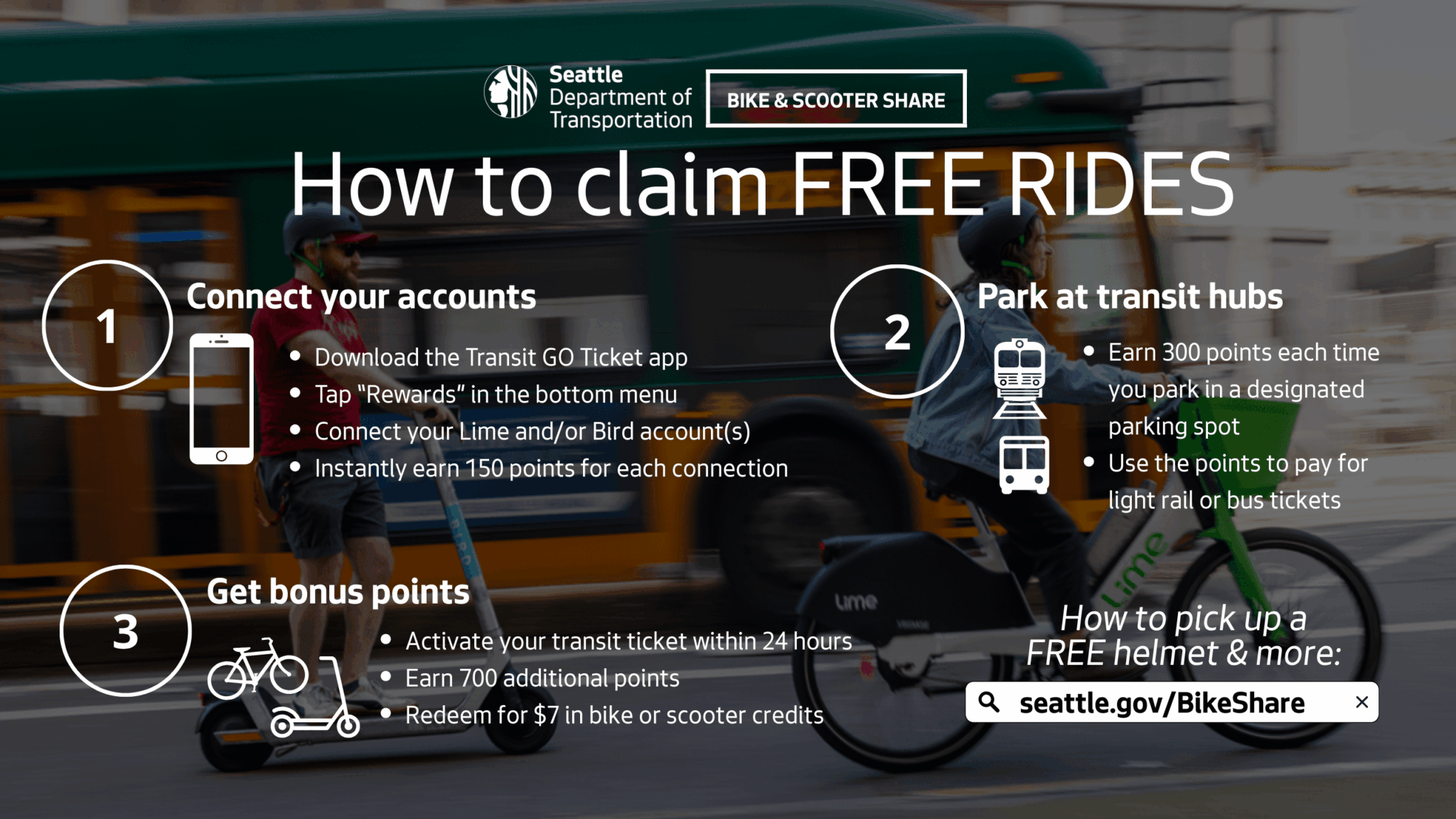
Free rides are available through the Bike and Scooter to Transit Program (while supplies last), and both operators Lime and Bird offer discounted rates for people who qualify.
Everyone deserves safe, reliable travel regardless of income or ability. In 2025 alone, people took more than 1 million rides using the discount program.
Small trips, big environmental benefit
Shared bikes and scooters connect people to transit and help people access daily needs – especially when it comes to short trips.
That’s a really big deal.
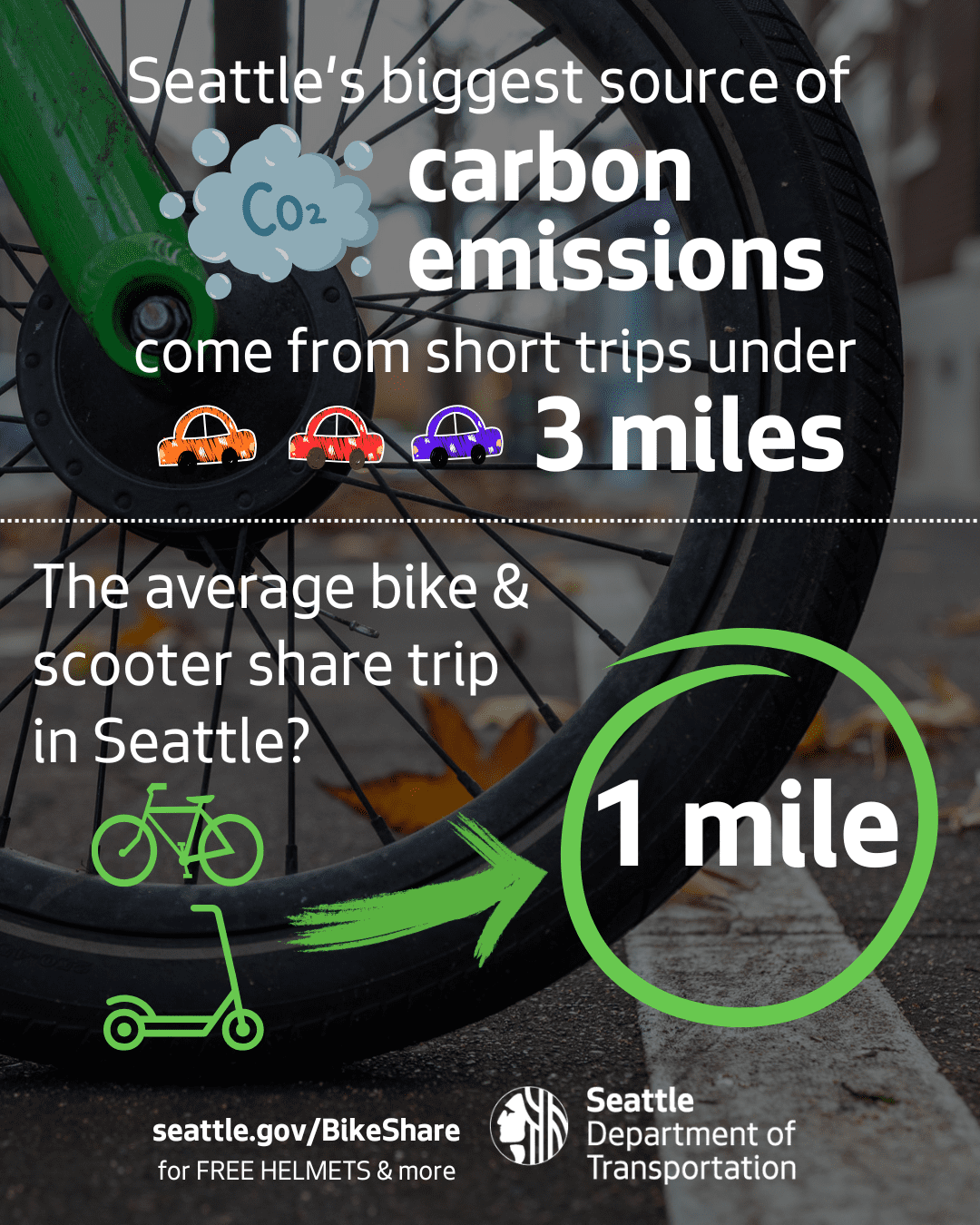
Transportation is Seattle’s largest source of carbon emissions, and most emissions come from trips under 3 miles.
The average shared bike and scooter trip in Seattle? One mile!
We don’t know exactly how many car trips were replaced by bike and scooter share trips. Some people who chose to ride may have otherwise walked, for example. But with an average distance of just one mile, it’s still very promising for the environment.
Bike and scooter share devices provide a zero-emission alternative for the short trips people take often.
For simple comparisons, let’s look at what this year’s 10 million-plus rides would have been if they were gas-powered car trips. For starters, that would have created approximately 4,000 metric tons of CO2.
With that in mind, this year’s bike and scooter share tips would have been about the same as:
- Taking 933 gas-powered cars off the road for a year. (Equivalent greenhouse gas emissions – Source: EPA)
- Growing 66,140 tree seedlings for 10 years. (Equivalent carbon sequestered – Source: EPA)
- Reducing traffic on Seattle streets by more than 26,000 car trips per day. (Average number of vehicle trips by distance – Source: FHA)
You can explore more on the Environmental Protection Agency’s Greenhouse Gas Equivalencies Calculator and the Federal Highway Administration’s Vehicle Trips Data dashboard.
Less traffic
Imagine an extra 26,000 car trips on our city streets every day. Oof.
On top of reducing congestion and improving air quality, bike and scooter share play critical roles in reducing strain on streets and our transit system.
As Seattle grows and prepares for major events like the 2026 FIFA World Cup, shared micromobility provides an innovative solution to geography and density challenges unique to our city – while supporting all other modes of travel.
Miles of new bike lanes
A connected bike network gives people using scooters and bikes a comfortable and safe place to ride, reducing riding on sidewalks, and 2025 was a big year for bike lanes in Seattle.
So much so, we had the opportunity to celebrate several key projects with the community during our Hot Bike Summer series of events.
Some highlights include new protected bike lanes in the Beacon Hill and Georgetown neighborhoods in South Seattle. (The Georgetown to Downtown and Georgetown to South Park safety projects were both completed in 2025 with one big Duwamish Valley celebration in September.)
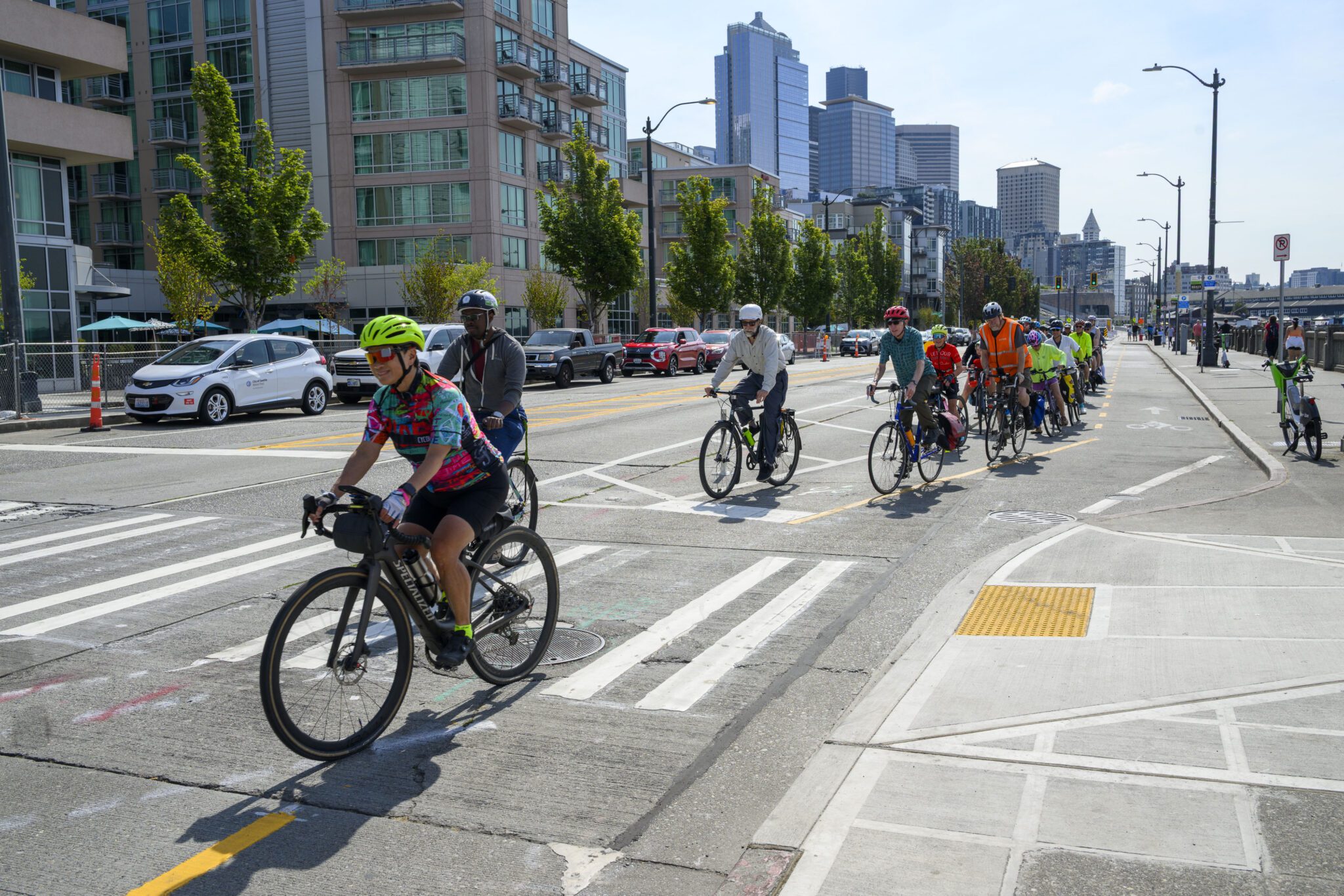
In August, we closed a critical bike lane gap on Alaskan Way between Virginia and Broad streets, allowing continuous biking around Elliott Bay without leaving a bike lane or shared path. This extension of the Elliott Bay Trail connects Olympic Sculpture Park, Uptown, Belltown, and Magnolia.
In October, we closed another vital gap along East Marginal Way, between Atlantic and Spokane streets, connecting West Seattle all the way to Magnolia.

The East Marginal Way project was particularly complex, supporting freight, bike, pedestrian, and industrial travel needs – all in one corridor. You can read more about it in this Seattle Times article, or on the project page here.
In total, SDOT added 9.17 miles of new protected bike lanes across the city in 2025, closing more gaps in the City Center Bike Network and beyond. Thanks to our Better Bike Lanes program, we also upgraded an additional 4.11 miles of existing lanes to improve safety and connectivity.
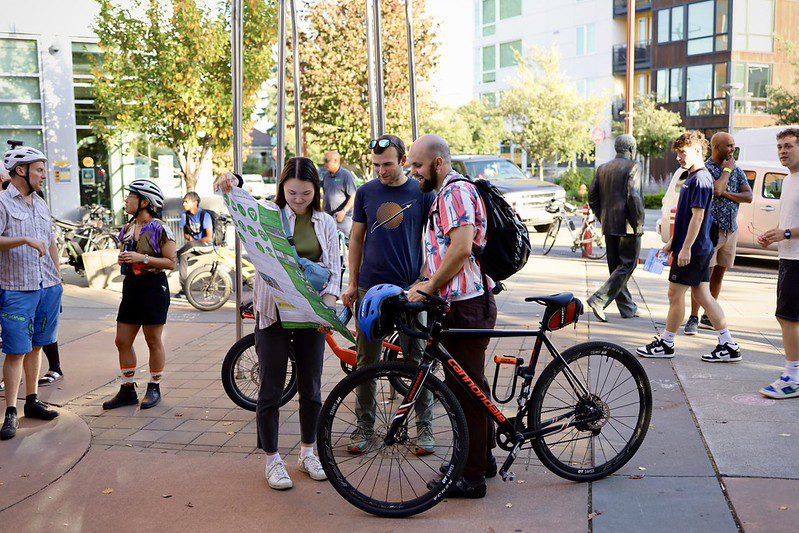
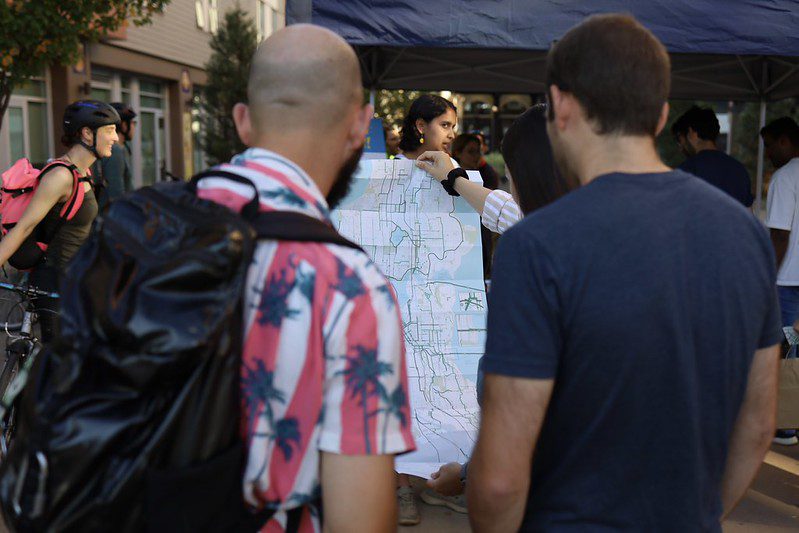
We also made significant progress on our neighborhood-scale projects – such as Healthy Streets, School Streets, Neighborhood Greenways and Safe Streets for All. Many of these initiatives include bike lanes, and all of them are designed to create safe, accessible paths for walking and biking within local communities.
Tripling bike & scooter share parking downtown
SDOT is more than tripling Seattle’s bike and scooter parking downtown by summer 2026 – ahead of the FIFA World Cup.
This past October, we began the first phase of our citywide parking plan, strategically installing 200+ new parking corrals where the data tells us they are needed most, such as:
- Popular destinations for bike and scooter trips
- Where incorrectly parked bikes and scooters have been ticketed
- Near FIFA event locations
- Near hotels
- Near transit and bike facilities

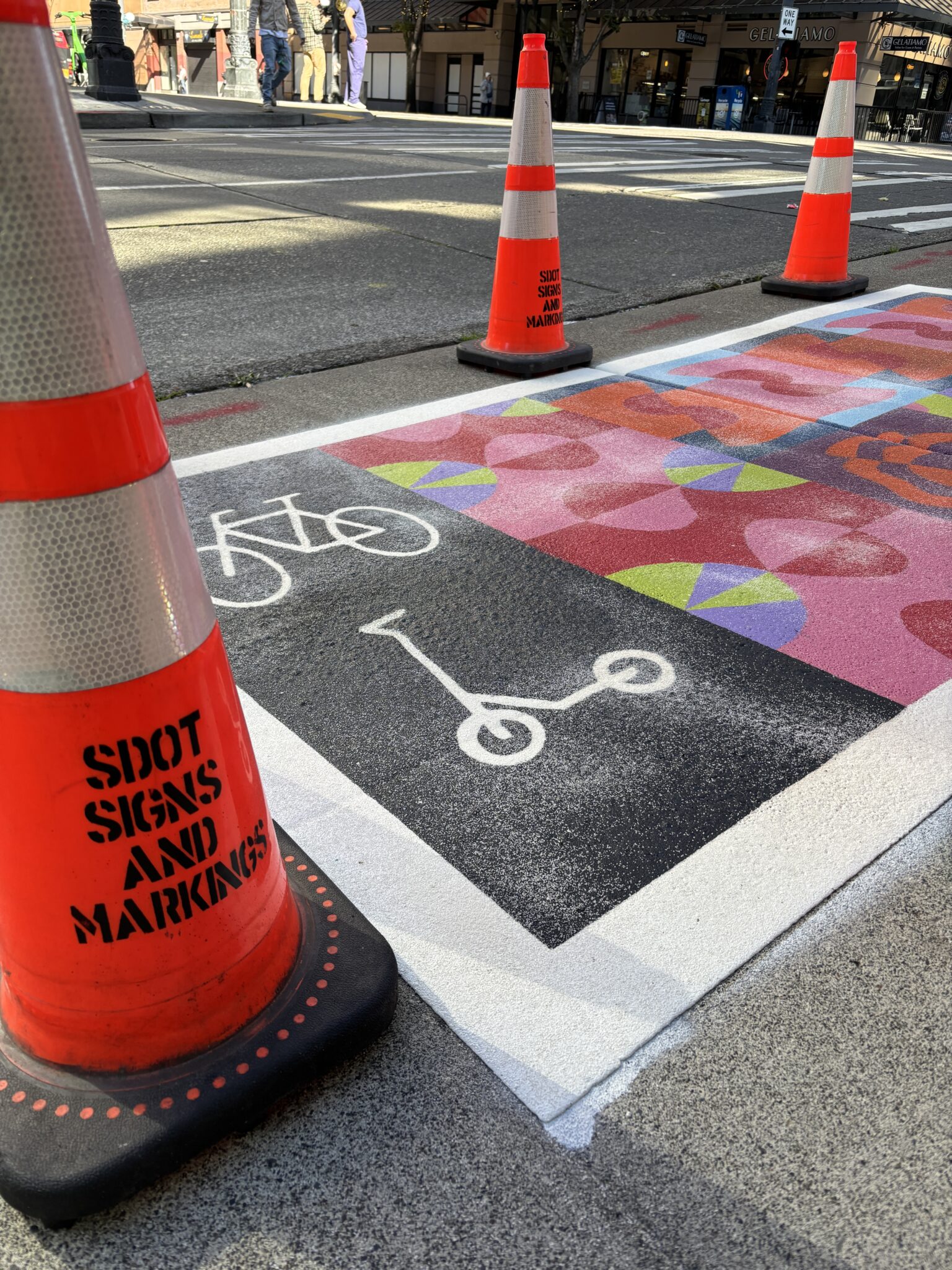
Some parking corrals have local art thanks to a partnership with the Seattle Office of Arts and Culture. The ones pictured were designed by artist Roy Franklin (Instagram: @eroynfranklin) and are inspired by the visual patterns of sound. You can find these corrals and others designed by Franklin outside Benaroya Hall.
All parking corrals will be ADA-accessible and built outside the main walking and wheelchair area.
Parking corrals make it clearer and easier for riders to park correctly, out of the way of people using sidewalks. They can also make our streets safer by daylighting intersections.
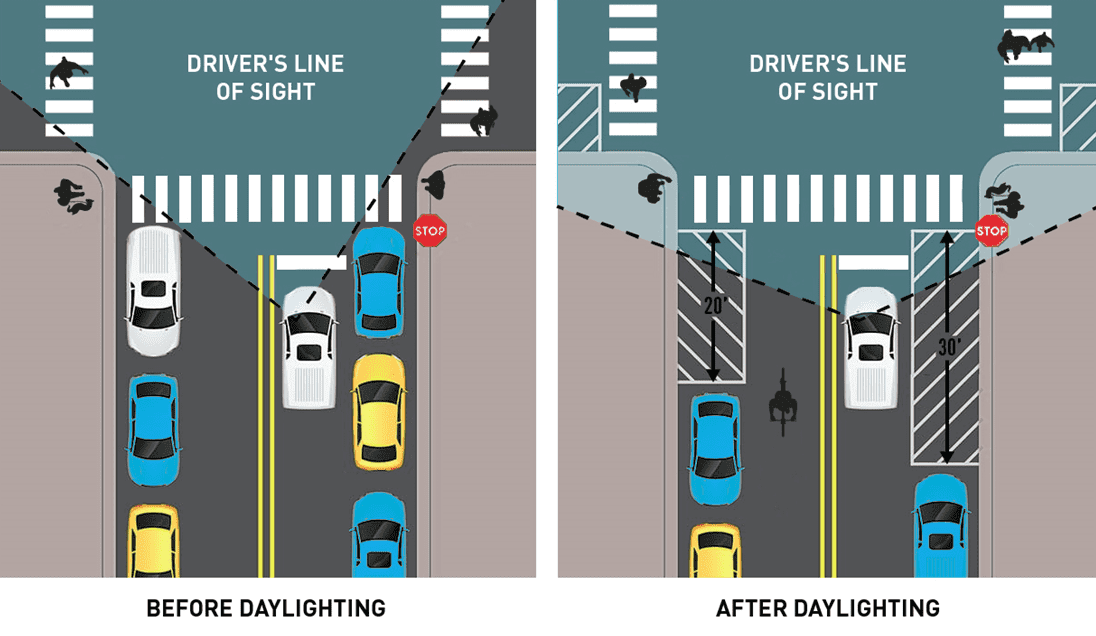
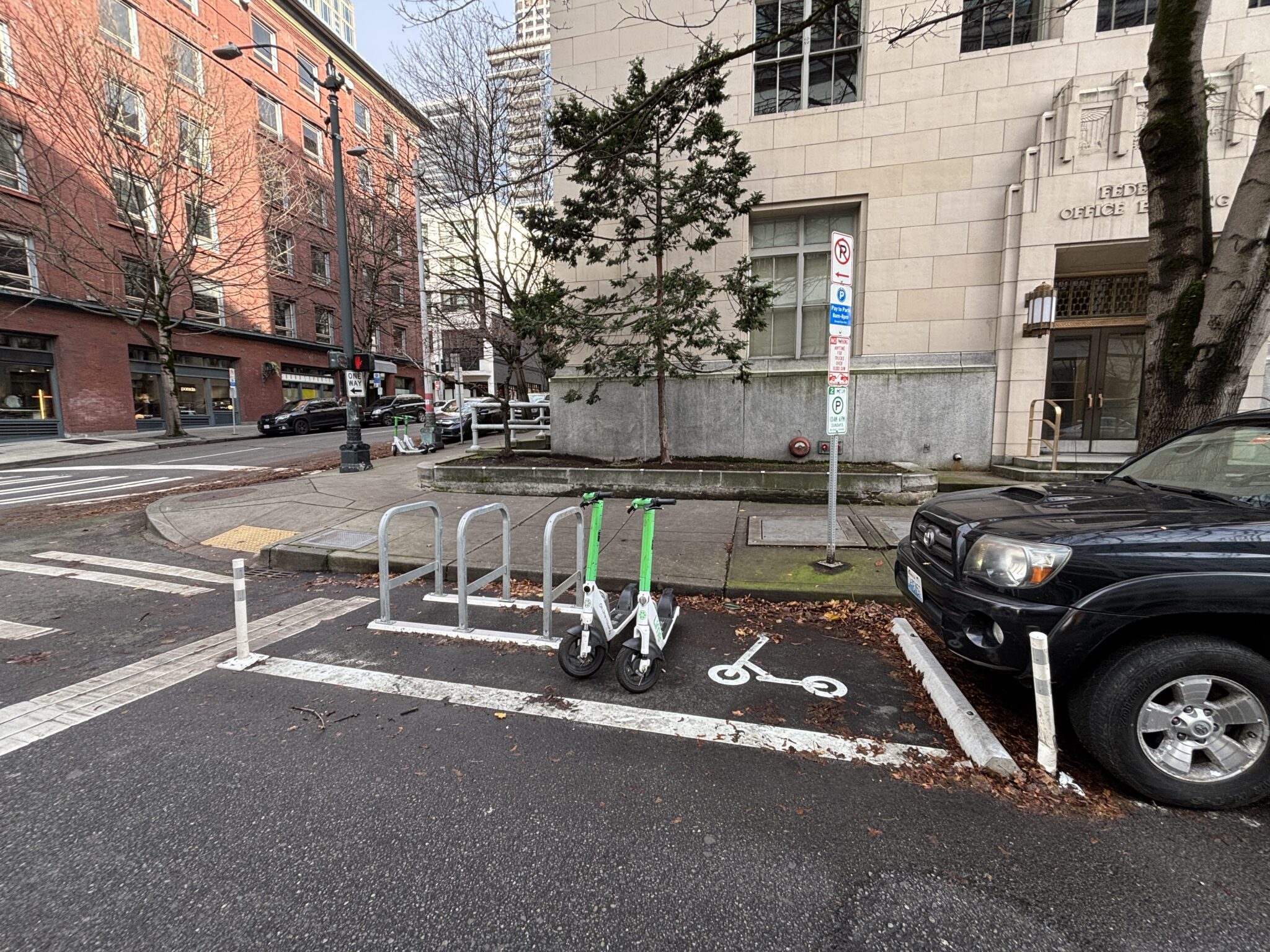
Daylighting is a way of designing infrastructure to widen everyone’s line of sight – especially drivers – making it easier for each person to see each other.
Check out this blog post for graphics and videos showing examples of how daylighting works in the real world.
Safety is always a priority
SDOT’s goal is to end all traffic deaths and serious injuries on city streets by 2030 through the Vision Zero Program.
While Vision Zero is its own program, the principals guide everything we do, including designing safer, data-driven infrastructure that supports bike and scooter share.
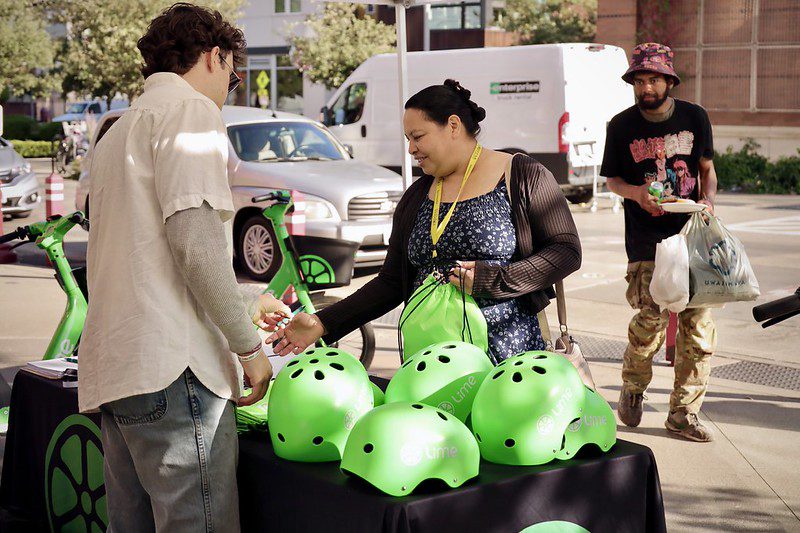
SDOT also partners with operators Lime and Bird to encourage safe riding. In 2025 we gave away more than 5,000 free helmets.
You can get a free helmet at one of our service centers across Seattle. Learn more about that on seattle.gov/bikeshare.
What’s next?
We accomplished a lot in 2025, but there’s much more to come.
In the years ahead, SDOT will continue connecting bike lanes to transit stations, schools, neighborhoods, and other safe riding paths—thanks to funding from the voter-approved 2024 Seattle Transportation Levy.
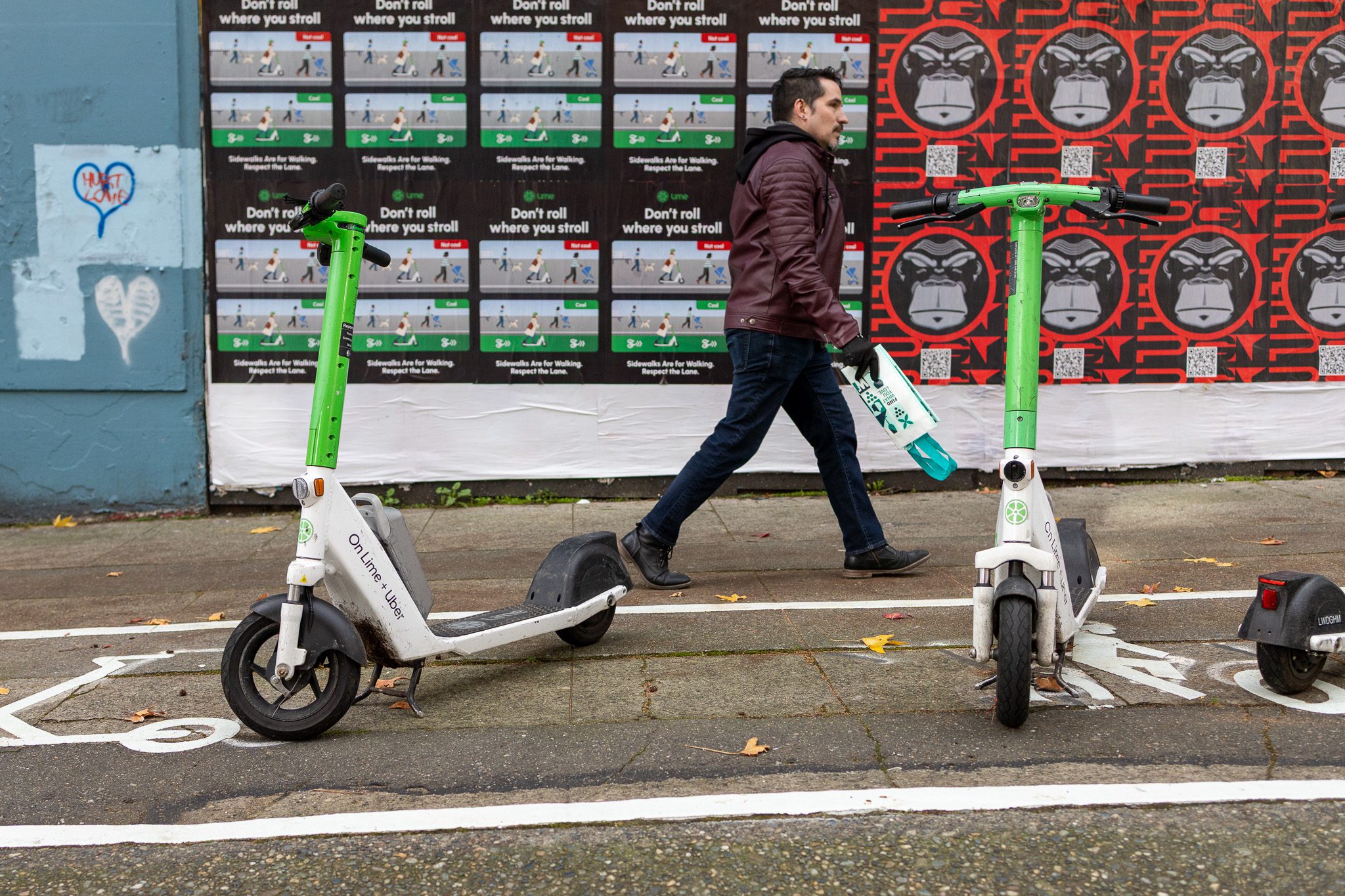
You asked for it, and we hear you loud and clear: more bike and scooter share parking is on the way. By FIFA World Cup, we will have more than tripled the bike and scooter parking corrals in Downtown Seattle. After FIFA, we will continue to add bike and scooter parking across the city.
If you would like to request a parking corral, you can send an email to walkandbike@seattle.gov for consideration.
As Seattle continues to grow, shared bikes and scooters are helping us build a more sustainable, connected, and vibrant city.
Learn more about Seattle’s bike and scooter share program on seattle.gov/BikeShare.
Editor’s note: we added numbers on discount program trips taken in 2025.