Seattle.gov Home Page
Link to Department of Transportation Link to Seattle.gov Home Page Link to Seattle.gov About Us Page Link to Seattle.gov Contact Us Page
SDOT Blog Home Page SDOT Blog Home Page CityLink Seattle

ASK US A QUESTION!

Have a question about our current work at the Seattle Department of Transportation? We’re ready to get you an answer!

Click here and scroll down

Search SDOT Blog

Archives

Contact us

Call 206-684-ROAD

SDOT Photo Gallery


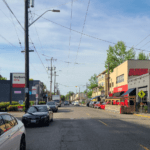
			SDOT Photos posted a photo:	Eastbound traffic on Mercer Street was shifted on Jan 30, 2012 to the newly constructed lanes on the north side of the street. The new, wider sidewalk is also now open for use.  Next, the contractor will work on the southern side of the streets. When completed, the street will be a two-way boulevard.

			SDOT Photos posted a photo:	Eastbound traffic on Mercer Street was shifted on Jan 30, 2012 to the newly constructed lanes on the north side of the street. The new, wider sidewalk is also now open for use. Next, the contractor will work on the southern side of the streets. When completed, the street will be a two-way boulevard.

			SDOT Photos posted a photo:	Mercer Corridor Project; South Lake Union, Seattle, WA

			SDOT Photos posted a photo:	Mercer Corridor Project; South Lake Union, Seattle, WA
More photos

Archive for 'Parking'

Isn’t It Pretty?

A lot of work went into repaving Dexter Avenue North from Fourth Avenue North to Roy Street, and the attention to detail shows.  Maybe we’re just paving nerds, but darned if it doesn’t look pretty!  Stand outs among the many improvements include two new crosswalks, dedicated transit islands at 10 of 12 bus stops and a buffered bike lane on each side of Dexter Ave N.  Here’s a trip down memory lane (all modes of travel welcome):

This complete streets project is a significant achievement in how it balanced the needs of cyclists, pedestrians, vehicles and mass transit – guided by the bicycle and pedestrian master plans.  Look for final touches of trees in the bus islands and plants in the rain garden over the next several weeks.

[More]

SDOT Celebrates PARK(ing) Day with a Latino Flair

On Friday, September 16, cities around the globe, artists and community members independently, but simultaneously temporarily took over and transformed parking spaces into public parks and other social spaces, as part of an annual event called “PARK(ing) Day.”

The Seattle Department of Transportation (SDOT) and Latino City Employees partnered with  Feet First to create a park to raise awareness about important issues like creating a walkable, livable, healthy city and to kick-off the Latino Heritage Month (September 15 – October 15). Latin American flags lined the space, spiking the interest of pedestrians and motorists alike. We invited people into our space where we had lawn games, chairs, music, and shared information about the City’s Race and Social Justice Initiative, SDOT services, and events to celebrate the Latino and Hispanic Heritage Month.

Over fifteen street parking spaces in Seattle, from Rainier Valley to Fremont, were taken up by PARK(ing) Day participants. Feet First collaborated with several organizations and individuals, including the City of Seattle, King County Parks, and Seattle Art Museum, to sprout 16 temporary parks this year.

[More]

15th Avenue NE Reconstruction Project Nearly Complete!

Update: Some finishing work remains and will be compltede within the next month to close out this important project!  Visit SDOT’s Flickr page to see construction pics!

In January 2011, SDOT began work on 15th Ave NE in the University District. The street was reconstructed between NE Pacific St and NE 50th St with new concrete pavement, and resurfaced between NE 50th St and NE 55th St with new asphalt. The project will be substantially complete September 16th – ahead of schedule and on budget! During the project, the team:

  • Placed 11,093 cubic yards of base rock and concrete in the new roadway – enough material to cover a football field 5 ½ feet deep!
  • Made 371 truck trips to haul away old pavement and gravel
  • Installed 52 new curb ramps to improve accessibility
  • Placed 6 new bus shelters
  • Redistributed street lighting and installed 4 new pedestrian lights and 7 new street light poles to improve visibility along the corridor
  • Installed 16 new stormwater catch basins and 49 filters to improve water quality
  • Created a new northbound left turn lane at NE 42nd St
  • Implemented a left turn restriction (transit only) during peak periods from northbound 15th Ave NE to westbound NE 45th St
  • Rebuilt 6,500 linear feet of sidewalk
  • Installed 26,913 linear feet of electrical conduit – enough conduit to wrap around the Husky Stadium track over 20 times!

Thank you to the nearby community for the support and patience as we completed this much needed improvement project!

[More]

W Thomas Ped & Bike Overpass Construction Begins

Construction to build the West Thomas Pedestrian and Bicycle Overpass begins next week, with some preparation work already underway.  Once complete, the new structure over Elliott Avenue West and the Burlington Northern Santa Fe (BNSF) railroad tracks will improve safety and access for pedestrians traveling from the lower Queen Anne community to Myrtle Edwards Park. The new overpass will also connect a future bicycle route, the Lake Bay Loop, from South Lake Union and the Seattle Center with the bicycle trail in Myrtle Edwards Park.  The following visuals give a better feel for how the overpass will traverse the area.

3rd Avenue W near the intersection with W Thomas Street


Crews will start construction on the east side of Elliott Avenue West, and begin work within Myrtle Edwards Park after August 29.  The project is expected to wrap up in spring 2012.

[More]

Why Bridging the Gap Alone Can’t Eliminate Seattle’s Maintenance Backlog

Earlier this year SDOT provided new estimates of our maintenance backlog and annual maintenance needs to the Citizens Transportation Advisory Committee and the Seattle City Council. Many folks have asked why these figures have changed so dramatically since 2006, prior to passage of the Bridging the Gap Levy.
 
During development of Bridging the Gap, SDOT estimated the deferred maintenance backlog to be over $600 million. This figure was based on very limited data about Seattle’s transportation system inventory and condition. It also excluded major bridge replacement needs such as the Magnolia Bridge, which was estimated at the time to cost over $200 million. Today’s one-time cost estimate to bring all parts of the transportation system into good condition is about $1.8 billion, a significant increase.
 
How did this number increase so dramatically?
 
Bridging the Gap was never supposed to fill the gap:  Despite the fact that Bridging the Gap doubled funding for maintenance of Seattle’s transportation system, it was never expected to fill the maintenance funding gap. In fact, with BTG and consistent levels of base funding, it was only anticipated to fill about 50 percent of the need for annual maintenance. This has allowed SDOT to stabilize the condition of some assets and improve maintenance cycles, but still leads to an increase in the maintenance backlog as needs are not fully met.
 
Base maintenance funding has gone down:  Bridging the Gap was developed in response to decreases in transportation funding, including the gas tax, prior to the Great Recession. Before the recession it was expected that base levels of city funds dedicated to maintenance would stay level. Due to the economic downturn, general fund revenue dedicated to transportation has declined almost 25 percent and gas tax revenues have continued to fall. This drop in base revenues for transportation has reduced base maintenance funding, boosting the rate of increase in the maintenance backlog.

Costs Continue to Rise while Base Revenues Decline

 
Increasing costs to fix the transportation system:  Despite the recession, construction costs for transportation projects have continued to rise. Since 2003, WSDOT’s transportation construction cost index has risen 68 percent, with almost a 30 percent jump during 2006, right when Seattle was deciding whether to move forward with BTG. Costs for asphalt paving materials rose even faster, up 80 percent since 2003, with a 34 percent jump in 2006. This rapid rise in costs to construct transportation projects has increased the estimated cost to eliminate the maintenance backlog.
 

Seattle’s transportation system has grown but funding hasn’t:  Bridging the Gap didn’t just fund maintaining the transportation system Seattle owned in 2006. It also had funds, over 30 percent, for making improvements to the system, increasing the overall size of it. Since 2007 Seattle has added 70 school crossing beacons, 20 new radar speed signs, 90 traffic cameras, and almost 20 message signs to help folks navigate our streets and increase safety. We also added signs, hundreds of street trees and new sidewalks, and striped new crosswalks, bike lanes and sharrows. Entirely new systems have been added to the transportation system, such as parking pay stations, the South Lake Union Streetcar and King Street Station. All of these improvements require maintenance and operations to keep working, but funding hasn’t gone up at the same time. This also adds to the backlog.

Read more »

[More]

Got a Parking Opinion? Express Yourself!

Parking. Whether it’s on the street or in a garage, it’s something that many people do on a regular basis. While people certainly don’t drive for the sole purpose of parking, the act of finding a spot is inevitable. We want to hear about your experiences.

At SDOT, we manage the on-street parking network – all those pay stations, meters, and related signs. Right now, we’re working on a project that outlines different strategies to make paid parking in downtown and neighborhood business districts more available. The technical term is performance-based parking pricing. Other cities like San Francisco, Los Angeles, New York, and Washington D.C. are testing out new strategies too.

We’d like to get a better sense for business owner needs, understand the customer parking experience, and look for ways to make it better. Take a survey! You can find the survey here – it should take about 10-15 minutes. Thanks!

[More]

SDOT Tests New CityPal Pay Stations

SDOT crews install new CityPal pay stations (click for larger image)

More than 2,200 pay stations line our city streets in neighborhood business districts and the downtown core making it easier for people to pay for parking.  Most people have become accustomed to using these high tech parking tools that enable parkers to use cash or credit to pay for on street parking.  These “smart” meters have enabled the city to allow pre-purchased parking and implement multiple parking rates throughout the city.

On Tuesday, June 21, SDOT installed two new “CityPal” pay stations on Western Avenue, just north of the Pike Place Market.  The CityPal is the newest version of the pay station and these are the first two CityPals installed in the United States.

The new units feature a 7-inch color touch screen that has been called an “iPad for the street,” capable of displaying not just parking pricing information, but also maps, wayfinding, and customer service messaging.  The CityPals also feature improved web-based maintenance and programming capabilities that can better handle multiple rates of parking pricing.  Despite the energy demanding features that CityPals provide, these units are fully powered by the sun through a top-mounted solar panel.   The international standard symbol for parking, an upper case “P”, is mounted high on the unit for visibility and the side panels are customized for Seattle with an image of the Space Needle.

The CityPal screen (click for larger image)

SDOT is renting and installing ten total CityPals to try them out during the next year.  Staff will test the functions and capabilities of this new generation of parking equipment and determine whether these units are a good fit for the city.

[More]

Parking Pay Station Problems

In Seattle a number of on-street parking pay stations recently experienced some technical problems. A cellular tower operated for our pay station provider, Parkeon, had signal strength trouble that intermittently prevented the stations from processing credit card transactions. The tower typically broadcasts a signal for eight to ten miles but sporadically had its signal strength drop to two miles.  

At any time from several dozen to 100 stations, out of 2,200 citywide, in the Pike/Pine, waterfront, Belltown and University District areas were affected by this cell tower problem. As SDOT worked with Parkeon to resolve the issue, parking enforcement officers in these neighborhoods were asked to be lenient in issuing citations, especially if there was any indication that the machines are not working appropriately.

Parkeon and its cellular service provider resolved the tower’s technical concerns early Wednesday morning, allowing the impacted pay stations to return to full service. As of Friday morning, only five stations were still experiencing issues, primarily because of their need to cycle through all the attempted transactions. 

If you were charged for parking but did not receive a receipt, have discovered multiple credit card charges or received a parking ticket in error, please call SDOT at 206-733-9241. SDOT will have those credit card charges and parking citations dismissed.

[More]

Now’s your chance to speak up about Seattle’s transportation system!


Citizens Transportation Advisory Committee members host a roundtable to discuss public health, mobility issues and Seattle’s transportation system.


Everybody has an opinion about transportation.  What’s yours?  Now’s your chance to be heard!  For details, please see our website.

Last fall, the City Council adopted Resolution Number 31240 which states the City’s intent to convene a Citizens Transportation Advisory Committee (CTAC) III to advise the Mayor and City Council on transportation funding alternatives and priorities. The 14-member CTAC III was appointed by the Mayor and Council and is hard at work developing recommendations for new approaches to funding improvements to Seattle’s transportation system.

Key to the process is guidance from the city’s engaged stakeholder communities. The goal is to develop a framework and shared vision of what is necessary to address the city’s commitment to affordable, safe and efficient movement for people, goods and services.

Read more »

[More]

West Mercer Place Open House March 15

The Seattle Department of Transportation invites you to an Open House for the “West Mercer Place” portion of the Mercer West project to be held Tuesday, March 15th, 4 p.m. to 7 p.m. at the Seattle Center.   The purpose of the Open House is to:

  • Provide the preliminary results of the study regarding  the “West Mercer Place” segment (Elliott Ave. W.  to 5th Avenue W)
  • Get feedback from the public on all parts of the study
  • Provide an opportunity to answer any questions about the overall Mercer West project.

A list of Frequently Asked Questions regarding the “West Mercer Place” study is available here.

The Open House will be in the Seattle Center’s Rainier Room in the Northwest Rooms Plaza  (Approximately 500 Warren Avenue N, Seattle, WA 98109 if you are using a GPS).  Due to the current budget, we are not able to provide any snacks, but we will have water available.

Getting to the Open House:
Walking directions
Bicycle directions
Bus trip planning
On-street parking and parking lots

We hope to see you there!


[More]