Seattle.gov Home Page
Link to Department of Transportation Link to Seattle.gov Home Page Link to Seattle.gov About Us Page Link to Seattle.gov Contact Us Page
SDOT Blog Home Page SDOT Blog Home Page CityLink Seattle

ASK US A QUESTION!

Have a question about our current work at the Seattle Department of Transportation? We’re ready to get you an answer!

Click here and scroll down

Search SDOT Blog

Archives

Contact us

Call 206-684-ROAD

SDOT Photo Gallery


			SDOT Photos posted a photo:	The Egyptian jackal-headed god of the dead stops by for a visit. The Pacific Science Center, SDOT, and a big old crane welcome Anubis to King Street Station 5/15/2012 . He in turn is here to welcome King Tut to the Science Center May 24, 2012-January 6, 2013

			SDOT Photos posted a photo:	The Egyptian jackal-headed god of the dead stops by for a visit. The Pacific Science Center, SDOT, and a big old crane welcome Anubis to King Street Station 5/15/2012 . He in turn is here to welcome King Tut to the Science Center May 24, 2012-January 6, 2013

			SDOT Photos posted a photo:	The Egyptian jackal-headed god of the dead stops by for a visit. The Pacific Science Center, SDOT, and a big old crane welcome Anubis to King Street Station 5/15/2012 . He in turn is here to welcome King Tut to the Science Center May 24, 2012-January 6, 2013

			SDOT Photos posted a photo:	The Egyptian jackal-headed god of the dead stops by for a visit. The Pacific Science Center, SDOT, and a big old crane welcome Anubis to King Street Station 5/15/2012 . He in turn is here to welcome King Tut to the Science Center May 24, 2012-January 6, 2013
More photos

Trees…Trees…Trees! Everywhere Trees!

SDOT crew hard at work planting a tree.

The Seattle Department of Transportation, through its Urban Forestry Division, is responsible for managing more than 40,000 trees in the public right-of-way (ROW) and maintaining 123 acres of landscapes.  Work to these valuable assets include pruning, planting, watering trees and landscapes, repairing irrigation systems and reviewing landscape plans for new developments.


Much of this work is funded through the Bridging the Gap (BTG) Levy and is helping the city work towards its goal of expanding the urban tree canopy.  Over the first five years of BTG more than 4,200 new trees have been planted and nearly 17,000 have been pruned.  This critical funding has allowed SDOT to reduce the pruning cycle from nearly 25 years to 13 years, improving the health of all SDOT managed trees! 

In the first quarter of 2012, 271 trees have been planted and Urban Forestry expects to have 400 new trees in the ground by May 1, the end of the spring planting season.  More than 350 trees were pruned during first quarter and that number will explode over the next several months as we move into prime season for tree pruning!  Urban Forestry will prune more than 3,000 trees this year and plant 700. 

Newly planted tree.


Having a healthy tree canopy is important for any city.  Trees provide needed shade, habitat for wildlife, reduce air pollution, minimize stormwater runoff, and make neighborhoods more livable and walkable.  Trees help make our communities more liveable.  If you have questions or would like more information about the SDOT Urban Forestry Tree Program please visit their website.  In addition if you have concerns about specific trees in your neighborhood please call the citywide tree line at (206) 684-TREE.


GreenDOT is SDOT’s Watchdog for the Environment

 Yesterday was Earth Day; but here in SDOT everyday is Earth Day!  And that’s not just lip service; SDOT’s  GreenDOT  team and program ensure that we continually evaluate our work activities to reduce our impact on the environment.  By following a four-step improvement model set forth internationally of “plan, do, check, repeat,” we are making tremendous strides!

Here are just a few examples of our many achievements:

  • Cut our CO2 emissions by a whopping 846 tons – that’s the equivalent of the fuel required to drive 1.5 million miles.  How have we done it? We have saved fuel by planning our travel routes, not idling our trucks, upgrading our fleet so that equipment can run  off  battery instead of engine power,  and using fuel efficient vehicles.  We are paving with “green concrete” whenever possible, and using warm mix asphalt when feasible (this also produces less air pollution).
  • Reduced the number of chemicals we use in our operations by an impressive 55%.  This has been accomplished by eliminating multiple brands of the same chemicals; eliminating products that weren’t being used; finding environmentally-friendly Best Management Practices to replace insecticides and pesticides; consolidating and replacing the majority of our paints with water-based  paints; eliminating products containing carcinogens or chemicals that target human reproductive organs.
  • Overhauled our operations – for example, monitoring construction site activities for best environmental management practices; adding BMP conditions  and improving  inspections  for  the right of way  material storage permits we issue; implementing more stringent permit procedures such as the process for removing or decommissioning underground storage tanks (USTs) which can leak and potentially contaminate soil and groundwater. 

We are pleased with our progress, but by using the international improvement model, we plan to continue fine-tuning all that we do to keep raising the bar beyond mere compliance with environmental regulations.

Keeping BTG Accountable

The Bridging the Gap (BTG) Levy Oversight Committee was established as part of the voter approved transportation levy in 2006.  A dedicated group of 15 community members, the committee meets quarterly to track the progress of BTG and ensure that the program is delivering on the promises made to voters. 

The group’s main function is providing accountability on the use of BTG funds.  This is accomplished through monitoring revenues, expenditures and deliverables at their quarterly meetings.  The committee has actively focused on how BTG funding is being incorporated into the various SDOT programs ensuring integration with the overall goals.  As part of their accountability process,  they have reviewed and commented on programs such as Complete Streets, the Transit Master Plan, the Bicycle Master Plan, and the Pedestrian Master Plan, and implementation of the Neighborhood Street Fund large project program. 

The committee believes that one way to assure accountability is to be accessible to the public.  To help ensure accessibility, each of our quarterly meetings is open to the public, with time set aside for people to share their views on BTG issues.  Over the five years the committee hasheld meetings in Meadowbrook, Ballard, Queen Anne, Rainier Valley, Miller Park, the International District, Downtown, Delridge, Northgate, South Park, West Seattle, and Georgetown.

The group has worked closely with SDOT reviewing BTG supported programs; providing accountability; and ensuring that BTG continues to deliver on the promises made to voters.  The committee members take their role seriously and will continue to ask tough questions of SDOT. 

For more information, please visit BTG Levy Oversight Committee website.

BTG Oversight Committee

Current members:

Committee Co-Chairs Ann Martin and Kristen Lohse, Ref Lindmark, Renee Stanton,  Allegra Calder, Betty Spieth-Croll, John Mauro, Charles Knutson, Barbara Wright, John Coney, Jeremy Valenta, Seth Schromen-Warwin, Bob Viggers, City Budget Director Beth Goldberg, and Councilmember Tom Rasmussen


Past members:

Barbara Culp, Thao Tran, Jeff Frkonja, Rick Sepolen, Christina O’Claire, Councilmember Jan Drago, Mayor Mike McGinn, Darryl Smith, Dongho Chang, Dwight Dively, Peter Whitehead, Chuck Ayers, Bill LaBorde, David Hiller and Holly Krejci.

Once Around the Web

Grrrr…A Tiger Can Only Do So Much

TIGER (Transportation Investment Generating Economic Recovery) is a USDOT grant funding program that communities and agencies can apply to fund larger and more expensive multi-modal projects. It’s one of the few remaining such programs. This year, the 2012 TIGER IV program received 703 grant applications. The applications total $10.2 billion, while USDOT has less than $500 million to award.   So only 25 – 50 projects will be awarded grants – that means, best case scenario,  93% (give or take) of those communities and agencies that applied are going to be disappointed to hear: No TIGER grant for you!

SDOT applied this year on behalf of the Mercer West Project and back in 2010, we were awarded $30 million in TIGER funds for the Mercer East Project.  We hope to hear in the next couple of months if we will be part of the lucky 7% or not. Cross your fingers! And maybe take a minute to think about how transportation projects can and should be funded – it’s a question that’s not going away anytime soon.

~

Did you know that people sitting in warm rooms are more likely to believe in global warming? Apparently it’s true. Chalk another one up for human stupidity!  On the plus side, if you’re celebrating Earth Day this Sunday with a climate change denier, try sticking them in a sauna and see if you can get through to them that way!

~

Walk like an Egyptian? Try, Walk like a Liberal!

Slate did an interesting piece this week (in tandem with Tom Vanderbilt’s great series, “The Crisis in American Walking”) that explored the correlation between high walk scores and liberal leanings. Here’s a snippet:

You might think it’s a simple matter of size: Big cities lean liberal and also tend to be more walkable. That’s generally true, but it doesn’t fully explain the phenomenon. Houston, Phoenix, and Dallas are among the nation’s ten largest cities, but they’re also among the country’s more conservative big cities, and none cracks the top 20 in walkability. All three trail smaller liberal cities such as Portland, Denver, and Long Beach. And if you expand the data beyond the 50 largest cities, the conservative/liberal polarity only grows.

If you have a minute, go read the whole thing. And if you’re just wondering what the Top Ten Most Walkable Large Cities in the US are – here you go:

  1. New York
  2. San Francisco
  3. Boston
  4. Chicago
  5. Philadelphia
  6. Seattle
  7. Washington, DC
  8. Miami
  9. Minneapolis
  10. Oakland

~

Lastly, Bill Nye, Seattle’s own Science Guy, talks about the city of the future. Spoiler Alert — the future is bike friendly!


(Monday – Friday SDOT sends out a compilation of local and national transportation news links. If you’d like to subscribe (or unsubscribe) to the list, just send an email to allie.gerlach@seattle.gov and I’ll take care of it for you. )

Cool Down and Count Up to Sustainability

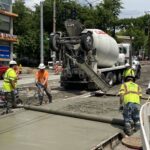
The effort to reduce SDOT’s carbon footprint has us counting up, as it were, and cooling down.  That’s because the more sustainable “green concrete” takes about seven days to cure, or solidify, whereas the more common mixture takes only three; and, the more sustainable asphalt is a warm mix versus a hot one.  SDOT’s NE Ravenna Blvd paving project is using both of these more sustainable road construction products.


By the way, there is such a thing as concrete that cures in just 24 hours but it is no longer the norm since it requires a lot of the key ingredient Portland Cement.  According to a 2009 New York Times article, “The manufacturing of Portland cement is responsible for about 5 percent of human-caused emissions of the greenhouse gas carbon dioxide.”  Portland Cement is what makes the gravel or other aggregate hold together to create concrete, so it’s a necessary evil, though new recipes are reducing the amount needed.  Of course, those new recipes mean more days for the concrete to cure so environmental responsibility is increasing the need for patience (another limited resource).

In the Ravenna project crews are utilizing green concrete for all base repair except where work is in the center of the roadway and traffic impacts for a full week would just be too significant.  In those instances a three-day mix (three days to cure) will be utilized.  All new asphalt along this stretch of Ravenna will come from a warm mix truck, meaning less heat on the street (about 250 degrees versus 300) and a significant reduction in the use of fossil fuels.  It’s good news for the earth, which we’re all counting on.

You’re Invited! Come Learn about Mercer West on April 24

The Seattle Department of Transportation invites you to an Open House for the Mercer West project!

Tuesday, April 24, 2012 from 4:30 to 7:00 p.m. at the Seattle Center – Northwest Rooms Plaza: Rainier Room

  • We are almost finished with the design of the project and will be presenting the final update for:
    • A wider Mercer Underpass at Aurora Ave N
    • Converting Mercer St and Roy St from one-way to two-way
    • Improved intersections, new street connections, and new bike lanes
    • Urban design and public art enhancements
  • Learn about other nearby projects and events

Visit the website for more information or to sign up for project update e-mails: www.seattle.gov/transportation/mercer_west.htm

Seattle Center is served by bus routes: 1-4, 8, 13, 15, 16, 18, 19, 24, 30, 33, and 45.

Si necesita esta información traducida al español por favor llame al 206-733-9990.

Si necesita un intérprete para la junta, la Ciudad de Seattle lo puede conseguir, si recibimos su solicitud al menos cinco días hábiles antes del evento.

How to get to the Open House:

Walking directions: http://goo.gl/maps/6zo4

 Bicycle directions: http://goo.gl/maps/d1zI

Bus trip planning: http://tripplanner.kingcounty.gov/cgi-bin/itin_page.pl?resptype=U

On-street parking and parking lots are also available: http://goo.gl/maps/70aQ

Consider a Sidewalk Garden for Your Home

Fruit trees in bloom provide an enchanting canopy over the walkway.

Have you taken a walk in your Seattle neighborhood lately to enjoy the early signs of spring? You may notice an occasional sweet smell that causes you to turn your head and search for the source. Or maybe you will round a corner to discover a cluster of bright red tulips along the sidewalk.  Perhaps the best of all is a row of flowering fruit trees that form an arch over the walkway. These spots of cheer provide a relief to the cold, hard pavement and an overcast Seattle sky. They may inspire you to start your own garden along the street in front of your own home.

Flowers and trees are not the only things you will see growing this time of year along Seattle streets. There are also occasional planting strips that have been recently prepared for planting vegetables, and some with cool-weather produce well underway.  More and more Seattleites are cultivating their planting strips–the area between the sidewalk and the roadway–to make good use of this space.

veggie garden

Low-growing vegetables can be grown in the planting strip.

While some planting strip gardens are casual and others more formal, there are important considerations for all gardeners who aim to have their work be a benefit, not a hindrance to their neighborhood. Public streets and sidewalks are meant to provide a safe and convenient right-of-way for travelers, including elderly or disabled persons. This means the full width of the sidewalk must be unobstructed by brush invading the walkway or by dirt spilling over from flower beds. Passengers climbing out of cars parked along the curb must be able to freely open the car door, step out, and get to the sidewalk without performing acrobatics over unruly shrubs or bumping into the hard-edged boards of raised beds.   Motorists emerging from their driveways or traveling down the avenue must be able to see far enough down the street and around the next corner to stay out of the path of oncoming traffic. Any obstructions must be well clear of traffic signs, fire hydrants and utility poles.

Raised beds work well in planting strips when adequate clearance is provided from the sidewalk and from the curb.

Help is available to gardeners who are planning to cultivate their planting strips. To ensure that streets and sidewalks remain safe and passable, there are city specifications that provide a design standard for planting strip gardens. Two client assistance memos from the Seattle Department of Transportation are available online, and Seattle Public Utilities has a Web page about growing food in planting strips:

There are neighborhood garden and environmental associations such as Seattle Tilth that provide encouragement and coaching to residents who want to transform previously overlooked areas of their property into productive gardens. You can sign up for a Seattle Tilth class.

Consider taking a walk in your neighborhood this spring to check out the planting strips, and plan what you could do in front of your own home to create a friendly sidewalk garden.
Gate

Planting strip gardens add beauty to your home as well as to your neighborhood.

Another Priority Bus Corridor is in the Works!

This week we’ll be celebrating Earth Day and it just so happens that last week SDOT kicked off work on the NW Market/45th Street Priority Bus Corridor, a project that takes the city one step closer to a sustainable transportation system.    Speedier, more reliable  transit service means more people can count on transit as a good option to  driving a car and that means less traffic congestion, fewer carbon emissions, and less air pollution.

The NW Market Street/N 45th Street Priority Bus Corridor project is one of several to get underway during the last few years.  Similar projects are in various phases in the Rainier Valley and in West Seattle.   The Market/45th project will provide a number of benefits designed to improve transit time and enhance the transportation experience on the Route 44 bus.  The project includes more than 20 individual locations stretching from NW Market Street and 28th Avenue NW in Ballard to NE 45th Street and Latona Avenue NE in Wallingford.

The first construction began at NW Market Street and 28th Avenue NW and at NW Market Street and 11th Avenue NW.  At NE 46th and Midvale, we’re adding a lane by re-configuring a landscaped triangle and also adding a right-turn lane on NW Market Street at 24th Avenue NW  (some parking spaces will be removed for this transit improvement). The project also  includes providing fiber connections to interconnect the 17 traffic signals along the route.  While this work is underway, SDOT crews will replace the signal controllers/cabinets at the 17 locations. 

Weather permitting, the project is expected to be completed in late summer 2012. The project is funded by the Bridging the Gap voter-approved transportation initiative and  a Washington State Department of Transportation Regional Mobility Group grant.


This Sunday Celebrate Earth Day

Seattle is aware that every choice matters. We also know that transportation is the largest source of pollution in the city and is an issue that impacts overall livability. This Sunday SDOT invites you to participate in Earth Day and help us make walking, biking and riding transit the best ways to travel. Below are a couple of events you might be interested in.

Earth Gay

Over 300 volunteers are restoring the northwest corner of Lake Union as part  of the fourth annual Earth Gay by OUT for Sustainability. The event is the most visible expression of environmental action by the Lesbian, Gay, Bisexual, Transgender and Queer (LGBTQ) community and their straight allies in the Pacific Northwest. Working on Lake Union’s northwest corner, volunteers will be building a water access point, supporting health of an urban forest, and planting 200 native species donated by King Conservation District as well as other activities intended to support the seven-mile Cheshiahud Loop Trail that rings Lake Union.

Next 50—Sustainable Futures Month

Earth Day marks the beginning of the Next 50 Sustainable Futures Month at  Seattle Center and starts with an opening ceremony presenting insights on the environment by elected officials and keynote speaker, Roberto Ascalon, Food Empowerment Education and Sustainability TeamCoordinator. 

Community members share what street bike markings mean to them.

The program also features an 11 a.m. Sustainable Futures Experience Exhibit ribbon cutting. The exhibit is located in the Next 50 Pavilion between the Armory/Center House and Experience Music Project museum. It is free and showcases the regions efforts around energy conservation, water and habitat, food and waste and mobility. The mobility exhibit touches on the importance of active transportation like biking and walking, mass transit, electric vehicles and the connection between land use and our transportation system. Love transportation? On May 19 the fun continues with the whole day focusing on mobility with tons of fun activities. Watch for more details. 


Big BTG Benefits for Neighborhoods …$10.7 mil and counting!

Bridging the Gap and Neighborhood Projects

Did you know that Bridging the Gap (BTG) provides $1.5 million a year to support the development of large neighborhood projects?

Before...

The Neighborhood Street Fund (NSF) Large Project Program is funded through the voter approved BTG transportation levy, adopted by voters in 2006, and every year the first $1.5 million helps fund this program.  The NSF large project program is set up on a three-year cycle allowing for larger neighborhood projects to be selected, designed and constructed.  The NSF large project program is currently in the second of three cycles.

After...

In 2010, 11 projects were selected as part of this process.  Those projects were designed in 2011 and are being constructed this year.  The city is funding $4.7 million over this three-year period for new sidewalk and bike improvements as part of this program.  This current process began with 37 projects proposed by different neighborhoods; projects were reviewed by the city’s 13 District Councils and ultimately vetted by the citizen-driven BTGLevy Oversight Committee.  Each project is unique and will make key improvements, making it easier to walk, bike andride across the city.

Before...

One of the most recent projects to be completed was the installation of a new sidewalk along NW 90th Street between 13th and 14th Avenues.  The six-foot wide sidewalk and new trees were planted along the north side of the route.  This project provides pedestrian access to transit corridors and local businesses.

The NSF program began in 2007 and during the first three-year cycle 17 projects were selected, designed and constructed. Recognizing the overwhelming need for neighborhood projects $1.5 million was added to the funding pot, bringing the total to $6 million for the first cycle.  At the end of this year, 27 new neighborhood based projects will have been constructed thanks to BTG.  The third and final cycle for submitting NSF large projects will get underway in late 2012/early 2013; information regarding that process will be available later this summer.

After...

If you would like to check out all the projects receiving funding or would like additional information, please see the NSF Large Project Program.